artversussport

This blog will be dedicated to the beautiful passions of life: Food, Film, Football (Barça), Philosophy, Literature, Art and Humanity.

Tuesday, December 23, 2008

Anecdotes


Anecdotes from Iceland
Edition of 50, printed on to the cheapest grey paper, put in an airmail envelope.
2007


Anecdotes from a hospital
Edition of 50, printed on to the cheapest beige paper, put in a brown b5 envelope.
2008

Labels: ,

Sunday, September 07, 2008

FEVER PITCH - an article from frieze

The art of football

Juergen Teller filmed himself watching the 2002 World Cup final (Germany lost 2–0 to Brazil). Eyes on the television set, he twists and shouts, stewing with bullish rage. He later said that this film was ‘the most disturbing thing’ he’d ever seen.1

‘Zidane’s melancholy is my melancholy,’ explains the narrator of a story by Jean-Philippe Toussaint. Watching the infamous 2006 World Cup final during which Zidane was sent off for headbutting Italian defender Marco Materazzi, he becomes absorbed by the player’s weariness, by ‘the intoxication of fatigue and nervous tension. I know it,’ he confesses, ‘I have nourished it and I feel it.’2

Harun Farocki’s 12-channel video projection Deep Play (2007) unpacks the visual archive of the Fédération Internationale de Football Association (FIFA) for the same match. Farocki’s spectators have to tear themselves away from his installation – even knowing the outcome, gallery-goers drop their masks of cool sophistication in their compulsion to watch this two-hour drama unfold again and again, from impossible angles and in overwhelming statistical detail.

Douglas Gordon and Philippe Parreno’s Zidane: A 21st Century Portrait (2006) pushes that geometry to a new level by training 17 cameras on Zidane for the duration of a Real Madrid match. Isolated from the game by the camera’s focus, we wait with Zidane for the pass, for the attack. The soundtrack layers Scottish band Mogwai and crowd noise, the slap of foot against ball and the scratch of Zidane’s boot against the pitch. Over 90 minutes he smiles and laughs once in an exchange with a teammate. The singularity of this moment tells us he is at work. The film reveals nothing so well as Zidane’s expert control over his face.

Unlike that of 20-year-old football stars, lithe from running around and fond of diamond studs and long, flowing hair (Dimitar Berbatov or Lionel Messi), Zidane’s is a hard, menacing beauty. Gordon and Parreno’s film would have had an entirely different tone had they chosen an exuberant or openly flirtatious subject. Ronaldinho smiles every minute he is on the field, no matter how badly things are going. David Beckham’s audience is packed with fewer Marxist art critics (who prefer their subjects miserable) and with more women and gay men – as was the case for Sam Taylor-Wood’s video David (2004), a film of the footballer sleeping which functions as a homage to Andy Warhol’s Sleep (1963).

Gordon and Parreno cite Andy Warhol’s films as an inspiration, but it is hard to see the connection: Zidane … is too beautiful, too controlled, too glossy. You can buy the DVD in supermarkets in France – a sign of how deeply the film co-operates with and expands Zidane’s celebrity. It has much more in common with Warhol’s portraits.

The real Warholian moment of football cinema is Hellmuth Costard’s film Fußball wie noch nie (Football as Never Before, 1971). A point of reference for Zidane… and due for a European DVD re-release this summer, the film takes the famously charming George Best as its subject and edits multiple camera views to produce a real-time portrait of the player singled out during the course of an entire match. Lest we miss the homoerotic subtext of football art (and football culture), the half-time interval features a cruisey bit of filmmaking as we follow Best through a narrow hallway and into what looks like the boot room. Best turns and faces the camera for nearly three minutes. He holds our gaze as long as he can, pursing his lips, looking away and then back in a seemingly overt homage to the Warholian screen test. Best strikes a deal here with the camera, inviting us to look at him when he takes the field again; shots of his socks, his shoulders and his crotch seem to go on for ever.

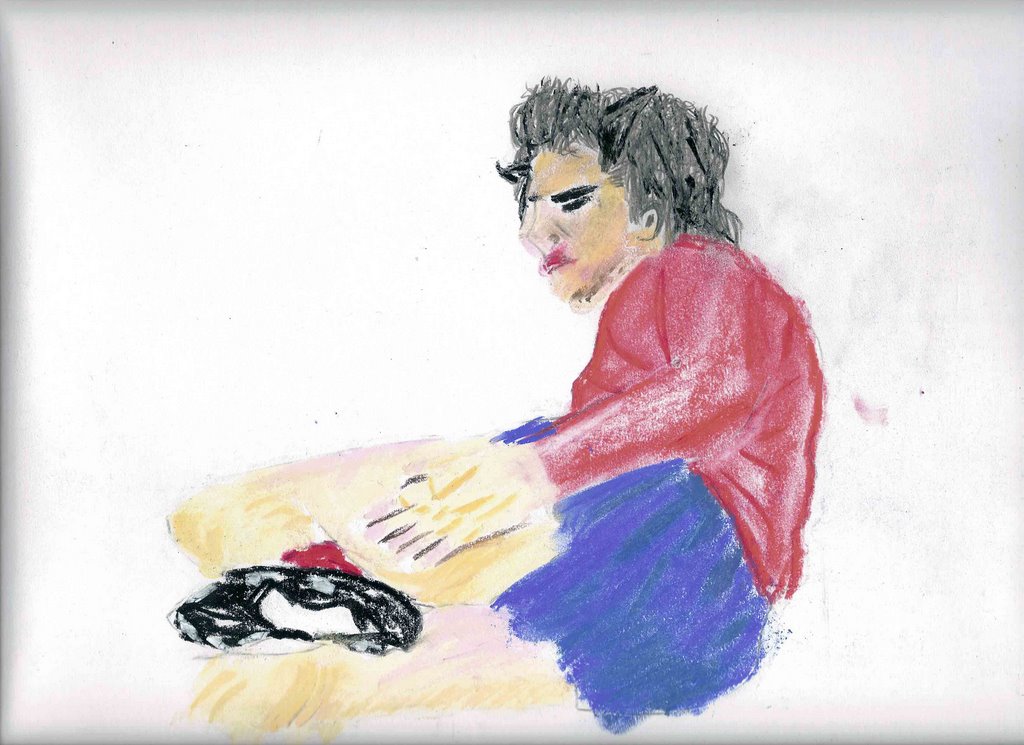
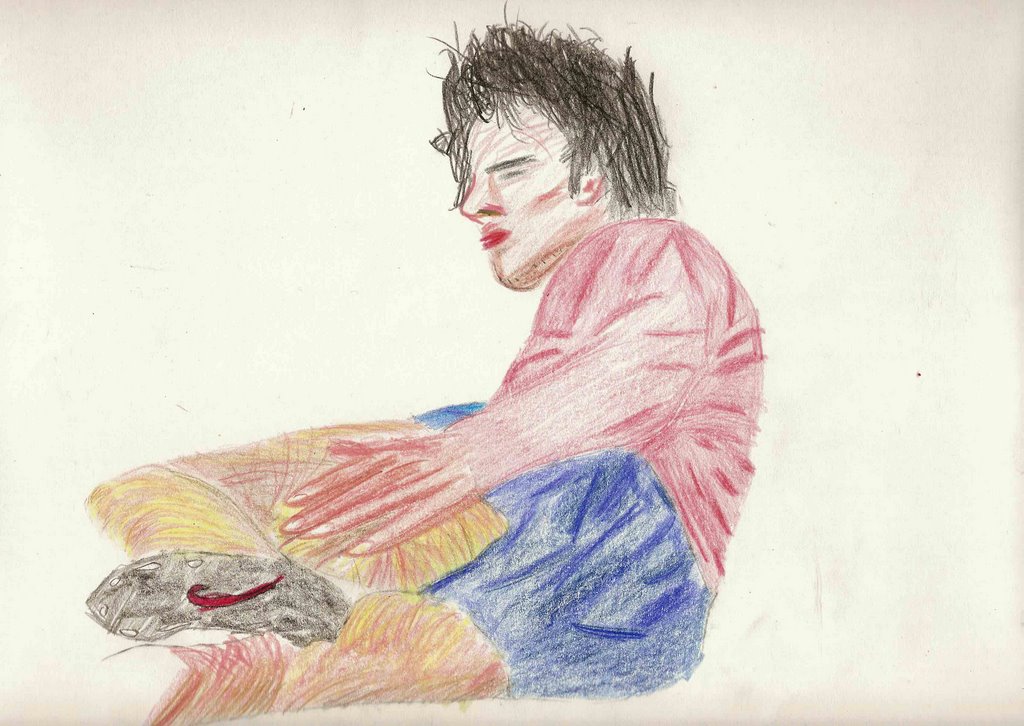
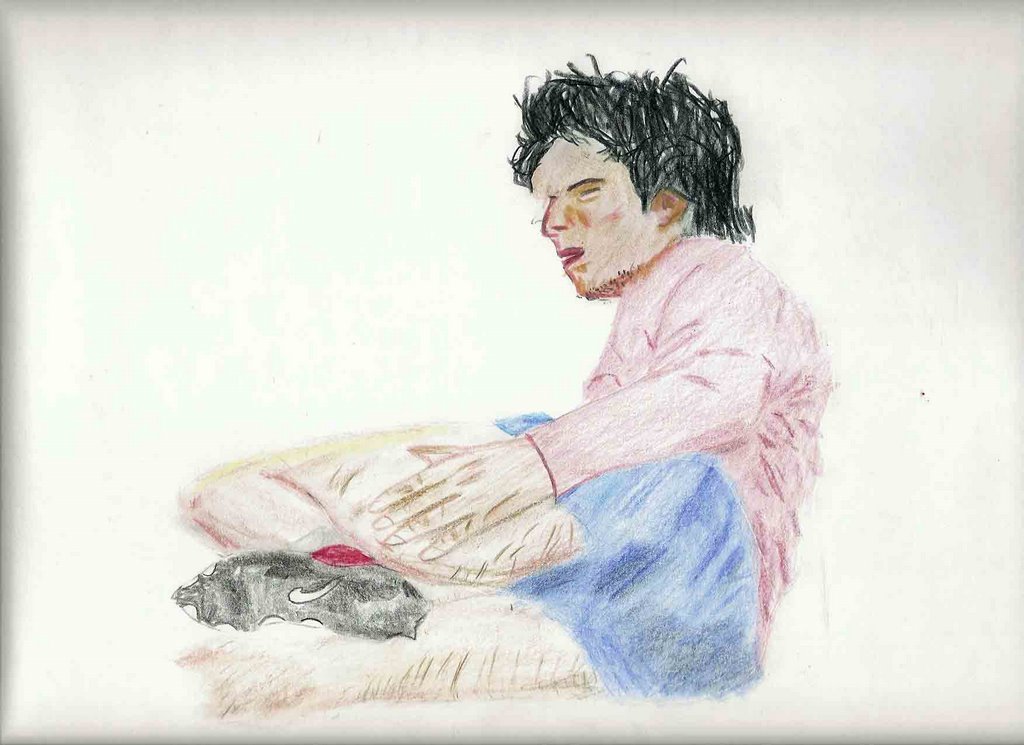
In her ongoing watercolour diary Yrsa Roca Fannberg sneaks onto Barcelona’s pitch. These small, moody paintings are close cousins to Costard’s film and an important counterpoint to work such as Deep Play and Zidane… Costard and Fannberg give the lie to the game’s open secret. Football is a deeply sentimental space of male intimacy. Players explode in ecstasy, but they also love each other in more ordinary ways. They collapse in frustration, they cry. They are lost and wounded. They wrap their arms around each other and talk.

Eduardo Galeano (the Roland Barthes of football writing) describes ‘the history of soccer’ as ‘a sad voyage from beauty to duty’. That ‘duty’ is paid to the sports ‘telecracy’, in which ‘functionaries specialize in avoiding defeat’.3 Artists respond to this aspect of the game with melancholy and nostalgia – and often both. In ‘big’ art such as Farocki’s installation and Gordon and Parreno’s film, both of which were made in collaboration with that telecracy, the game itself is a receding horizon of pure experience in which the player dissolves with a pivot and a swing of the foot. His body – how it feels to be him – is beyond the reach of any representation. Technology and telecracy unite in the erasure of the player’s body, and his pleasure, from the picture. Roca Fannberg counters that theft by choosing as her medium a very simple dissolve of water on paper to capture how our moods, our thoughts, our legs get entangled with theirs. If the player dissolves, it is with us, and in tears.

The game is excised from the less romantic experimental film Substitute (2006) but not out of any formal trick. Fred Poulet gave his friend Vikash Dhorasoo a Super-8 camera so that the latter might keep a cinematic diary of his summer performances for the French national team during their 2006 World Cup run. The project was a disaster. Dhorasoo’s teammates refused to be filmed. Some, such as Zidane and Thierry Henry, are global brands; their images are trademarked. In spite of having featured in qualifying matches, Dhorasoo scarcely left the bench – many think the film project was to blame. Filming training is off limits, and the telecracy owns the game. The camera isolated Dhorasoo; we hardly ever leave his hotel room. His footage is grainy, often out of focus, while the narrative is sparse and grim. We track Dhorasoo’s struggle to keep his alienation and bitterness in check. Poulet and Dhorasoo replace the macho heroics of wounded masculinity with a far more compelling truth of exile, desire and resentment. The film ends not with a defiant geste but with Dhorasoo climbing the stairs to his apartment and sitting down at a table to open a large stack of mail.

1 Cited by Liz Hoggard in ‘This is for You, Dad’, The Observer, Sunday 14 September 2003
2 Jean-Philippe Toussaint, ‘Zidane’s Melancholy’, in New Formations: A Journal of Culture/Theory/Politics, 62, 2007, pp. 12–14
3 Eduardo Galeano, Soccer in Sun and Shadow, Verso, London, 1998

Jennifer Doyle

Jennifer Doyle is the author of Sex Objects: Art and the Dialectics of Desire (2006) and blogs about football at From a Left Wing.

Labels: , ,

Tuesday, March 25, 2008

Calvinistic Children

I can't confess so I will leave this moment of doubt in the hands of God who will inform me later on if I can celebrate or not...
I leave you these pictures in the meantime, that I took.
Let's hope the Álfar will help us. My grandmother has sent her protection army (Álfarnir)


Labels: , ,

Saturday, March 08, 2008

Slide Show at the Barbican

FREE EVENING AT THE BARBICAN
Main hall (level -1)
From 9.30 until midnight (with Bar)

SLIDE SHOW

51 artists responding by email to the Barbican strapline
DO SOMETHING DIFFERENT

a proposal by International Exhibitionist

Katarzyna Kozyra, Dan Graham, Thomas Rentmeister, Matthieu Laurette, Nooshin Farid, Marie-Ange Guilleminot, Grace Ndiritu, Orlan, Aneta Mona Chisa & Lucia Tkácová, Claire Fontaine, Flávia Müller Medeiros, Shezad Dawood, Antoine Catalla, Martin Zet, Laurent Moriceau, Caroline McCarthy, Bruno Peinado, Antony Gross, François Curlet, Andro Semeiko, Toine Klaassen, Yu-Chen Wang, Gordon Cheung, Charbel Ackermann, Shoko Maeda, Mathijs Lieshout, Mairéad McClean, Valérie Vivancos, Julien Blaine, Valentin Torrens, Simon Faithfull, Anne Cleary & Denis Connolly, Bernadette Genée & Alain Le Borgne, Ross Birrell, Jan Kjetil Borheim, Mamuka Japardeize, Enna Chaton, Yrsa Roca Fannberg, Patricia & Marie France Martin, Adina Bar-On, Vincent Julliard, Roddy Hunter, Michael Asbury, Van McElwee, Doug Fishbone, Adam Nankervis, Giacomo Picca, Pierre Bastien

Invitation by Barbican Education

Specific slide shows will be presented in between performances.

Programme :

9.30 Performance by Ken Campbell & the School of the Night + music by 5 performer

Slide show

10.05 Performance by Julian Fox

Slide Show and short films : Chelpa Ferro - Martin Zet - Pierre Bastien

10.55 Musical performance by Paul Granjon

Slide Show

11.45 Musical performance by Scanner

Midnight Performance by Lone Twin ends in Silk street.

Ps.
It should be availabe at this website sometimes soon:
http://international-exhibitionist.org/

Wooohoo I can finally put on my CV that I have been in the same show as Dan Graham :)

Labels:

Sunday, November 11, 2007

Interview - Frank Rijkaard - the real thing artversussport


A New Year Is Always A New Year - Interview Frank Rijkaard

I met Frank Rijkaard for a brief chat that perhaps did turn out to be as brief as planned. I have to admit that perhaps my first questions were almost like a psychoanalytical session, but I hope they give some insight into what there is behind someone who has tasted a lot of success, but still is able to keep things in perspective. Rijkaard is very impressive in real life; Strong and Tall and Big, with that gaze that projects intensity behind the calm wall of this exterior being.


Q. Where do you belong now? Catalonia, Italy, Spain, Holland or are you just a modern European?
A. To nobody, I just belong to myself. I have had the opportunity to live in many places, take in from all these cultures, but I think I just belong to myself. But I am just myself that is whom I belong to.

Q. What is your relationship with the former colonies of Holland? Do you feel close to them? In what way have they shaped you?
A. Obviously I am (pause) coloured, but my mother is Dutch, my father is from Surinam, you take something with you from all of them and I am very proud, both of my mother and my father, but I see myself as Dutch.
I don't like to talk about people in those terms, as I never think of people like that. People always have this need to put everything in a set box, but I am not like that I never think of this person or that person as this or that. I just think of humans.

Q. In what way does the ego reflect itself as a player and as a coach?
A. It is very different (emphasis on different), when you are a player, you have only yourself to think about, obviously you have to think of the team as well, but it is an individual challenge and responsibility. As a manager it is much harder, not physically of course, but mentally, your responsibility is totally different. You have a whole group to think of.

It seems like Rijkaard is able to keep his integrity intact, and sometimes he seems both aloof and distant from what can be the petty business of competitive football and all that glory surrounding it. Some other coaches want to be in the centre of attention. Demanding higher salary than any player, as it is generally thought that there is the outmost respect for the one who earns the most. He seems able to put his own ego aside, something rare today as those who have tasted all glory, tend to want to keep tasting that glory. Respect is not gained by banging your fist or by shouting, but through that gaze and that tiny raise of a tone. I believe the method of individual responsibility and the guilt that comes with taking advantage of that freedom can be much more effective, even if last years complacency contradicts that. Perhaps this year, with the competition within the squad and embarrassment from last year, self-criticism will take place (on behalf of everyone, players, coaching team, board and the Catalan press).

Q. Do you think that as a public figure you have to adapt positions that perhaps you don't identify with and how do feel about that?
A. I am a coach and these are the things I get involved with, I just stick to my job and don't get involved with issues that have nothing to do with my profession, which is a manager of a football team.

Q. How do you see yourself from other coaches and what do you think of a certain rivalry with some of them? Is it just boring or is it just part of the game? Sometimes it seems a bit like "machos" having something to prove between themselves, at least from a female perspective and in one way you always seemed to avoid that confrontation.
A. It is not really my problem (with an authoritative tone), as I just tend to stay away from it, the press sometimes wants this or that, but as I said it is not my problem really. So I never really have any difficulties with it, as it doesn't affect me.

Q. To be a successful coach, even if there is no strict formula, how much percentage would you apply to:
Institutional relations, relations with players, relations with press, tactical knowledge?
A. There is no such formula, sometimes it is due to the players, sometimes it is due to the coach or the fans, or the press, it just depends on each situation and it changes.

As it has been well documented Barcelona lost the title to Real Madrid, even if the title was only decided in the final game, it was thought that Barcelona lost the title well before that. I had an instinct, perhaps based on my Icelandic grandmother’s elves instinct that it would be a dry year (and the year before it was an instinct of glory), which perhaps made me look for signs, but the complacency was there, already before Christmas, the eyes of the players when they went on the pitch did not match the determination of previous years. It could have been down to a variety of reasons, but one is that Rijkaard had lost that control of the dressing room, he had lost the virtue that perhaps was his biggest virtue, the don of complex dressing room psychology.

Q. Now everyone seems to call for you to become a tough guy, is it not almost impossible to suddenly be someone with a machine gun? Is it old fashioned and archaic to impose that kind of authority. Is it possible to suddenly change the whole method of working?
A. It is not really about being a tough guy, to suddenly have to be different. It is just that you have to act as soon as you see something you don't like. We as managers have to take actions, when they are needed, rather than allow it to self-digest. Last year there were some internal problems, and we want to act quicker, be more on top of things. We (I think he is referring to the team) will just have to go back to the hard work and be a unit, to have solidarity between us.

The club in some ways or another suffers from the so called Cruyff Ghost, it shapes philosophies, the current board is mildly pro-Cruyff. The media is keen for the club to adapt the philosophy of attacking football, forgetting that in modern football that is almost utopian. In the Champions League there is no way you can get away with a light weight midfield and one of the tactical base of the team that Rijkaard had shaped: defensively solid, aggressive in retrieving the ball and cohesive. The year the Champions League was won, the club did not concede a single goal from open play, it had a fierce defence (that started with Eto’o). That was all forgotten with success. Suddenly players were not willing to put in that extra gear. The press started to promote the idea of an all attack. This year they have already invented the ridiculous name The Fantastic Four, it remains to be seen if Rijkaard will stick to his own idea of a mixture of Italian football and an attacking football or if he will go for the cryout of The Fantastic Four. The pressure is on.
My belief is that Henry was signed to keep the other strikers (especially Ronaldinho) under pressure, in previous years most of his substitutions (Ezquerro, Gudjhonsen, Saviola) seemed two or three scales below him, even in his worst form. So far the four signings that have been made (Yayá Touré, Milito, Abidal and Henry) are all players that most likely will make the first eleven, which will make other players (such as Márquez, Deco, Xavi) try that bit harder.

Q. In a way both Ronaldinho and Henry are used to total freedom on the pitch, is it not impossible in modern football to play both of them?
A. We will try things out, especially now in pre-season, but if it doesn't work then only one of them will have to play

Q. Sometimes it seems like Barça have no Plan B, at least last year (something that was very successful in previous year) and why is that? Sometimes it feels like the team has a certain difficulty in progressing, defending from corners, change of tactics, scoring from corners?
A. People say last year was so bad, but we conceived the same goals, so I am not sure that is true, obviously it was not a successful year, but we are here to work hard on achieving our goals. I don't really want to talk of last year, as that is last year. We have to think of what is in front of us. The past doesn't matter. We just have to wait and see.

Q. What plans do you have in mind for Eidur Gudjhonsen?
A. It is a bit difficult to say, as he is injured at the moment. He has a knee problem. I could say that he is a great player, good person, but it is not possible at the moment to evaluate the situation fully. Last year was a difficult year, for the team and for him, and this year the competition will be even higher, we will just have to see.

Q. Was there an external pressure on applying 3-4-3 or is that system plainly utopic?
A. We tried it out once, and it worked in an excellent way. We wanted to surprise and we did as manner, as we went through that qualification. Then we wanted to try it in other games, but it just did not work, so I guess that was that really, as it wasn't a surprise anymore.

Q. I think what made the team so successful was the combination of beauty and team spirit.
A. I don't agree there, work and hard work has always to come first, you have to work hard as a unit and then maybe, but maybe beauty can come on top of that, but beauty can never ever come first, it just doesn't work like that.

Q. What can we learn from last year (somehow insisting) ?
Can you describe your emotions over the last two years from Paris to Tarragona?
A. Well you always learn something, and also from last year. It is obvious that perhaps it was not a great success, but I don't really want to talk about the past, it is the past and we just have to take that experience into this year and work hard, something we are doing.

There were rumours earlier this summer, that the coaching team was contemplating a change of captaincy, not for the first one, but on the second and third (an idea that seems abandoned now). It was thought that Xavi the third captain was too bland and Ronaldinho too bad of an example. Rijkaard said at the end of last season “That Puyol had felt isolated at times”, referring to his captaincy and authority within the dressing room.

Q. What do you want from a captain? What is the difference between the first, second and third?
A. A captain is an authority within the group, chosen by the dressing room, and it has to be someone who has the respect of the other players and is there to deal with any issues that come up, and he is a very important figure within the group. The other captains are his assistants; they are there to help the first captain and Carles Puyol is our real Captain.

Barcelona have strong tradition of bringing up players from the youth teams. In most cases they are allowed to grow in to the first team, slowly, allowing a certain progression. There is a risk that with the explosion of Messi (where they intended on a slower progress, which was made impossible with his sheer talent) that each player coming up will be expected to be The New Maradona. This year expectations on both Bojan Krkić (16) and Giovanni Dos Santos (17) are high and it is thought that rather than being squad members, gaining experience they will the 5th and 6th striker of the first team.

Q. How and what approach do you take in the educational aspect of the players, not only regarding sport performance, but also personal development?
A. If they need help I help them. It depends on each individual. Some players are very open-minded and are willing for that help, while others for whatever circumstances are more closed, making it more difficult to enter, but I always try to be there in case they need something,

Q. What is the best way of integrating youth team players?
A. You don't, they basically integrate themselves. The players see when somebody has talent and it just goes from there. Nothing can stop talent.

Q. What was your impression of the club, when you first came and how do you look at it now?
A. When I first arrived, everything was new, after some time, you know how it works, you know it is a complicated club, you know that is more than a sentiment, that it represents something else, but you just have to work and concentrate on that, I never really get involved with those external questions as I just want to be professional and concentrate on my job, and do it as well as I can and it is an honour to coach this club.

It looked like the season would be affronted with maximum excitement and optimism, that the club had bought well and wisely. It was believed that the past had served as a learning curve, but unfortunately it does not look that way. It is not that the team has played badly in the three games this season, but it is a mirror image of the past year. It is more like a collection of individuals rather than a team unit and rather than the new players will put pressure on the old ones, it is feared that they the old players have passed their complacency on them. The board is rumoured to be looking at other options at the bench and that Rijkaard has until 7 October to enhance the play and put some order in the dressing room.

Can Rijkaard possibly reconduct the situation, is he really the right man for the job? Or is the old cliché that what you fell for in your lover is what you end up annoying the most.


Images

Uefa Champions - Not much to say really, one of those press conferences. I actually wanted to do another one, but lost the image, where I really liked the squares/patterns the adverts behind make. Next time.

Storming - watercolour - alright, messed up Rijkaard's nose and the face of the anonymous Barça player. I think this was against Chelsea, when he was very very angry.

Storming - dry pastels - alright.

Fish shop - Another of those made on the oooo aaa iii watercolour paper. I like it, finally it works. I think.

Container - The scan is awful, it is one of the first ones I am satisfied with and actually manages to look better on paper than scanned. The paper I used is a "SERIOUS WATERCOLOUR" paper (think said about Coltrane - Serious Jazz), it was left by a friend and oooo aaaa iiii - so nice to use.

By the way, that interview was made in the summer, late summer for my countries papers. It was almost a surreal experience. My first ever interview and eye to an eye with the man himself. I will tell you more later. There are some amusing anecdotes.

Labels: , , ,

Sunday, November 04, 2007

Smásaman (bit by bit, poc a poc)


I have to admit I am really happy with this one. This is Frank. Rijkaard, I think last year after the game at Stamford Bridge. He is in thi middle of sea of blue/white flags.


This is kind of what I am aiming for. I just did the background too be honest, but this is what I am striving for with my watercolours. Long way to go and I guess the beauty is not knowing if I will reach there.


I kind of like this one.


Think I like this. Just have to make a watercolour out of it.


I was happy when I made this one, although I made a total mishap/mess of the stairs. Guess I can always photoshop... But no.


I was sad when I made this.


The two sketches of the fish shop in central Reykjavík don't serve for much apart from the "so called creative process".


This is kind of the finished version, although I might re-do it.


Interesting (said in the British way). The colours were totally mis interpreted in the scanning process.


This was the first one. I kind of like the floaty effect on the walls, but it is not really what I am looking for.


On the way somewhere. The originial image was not so so interesteing but I do like putting down names and incidencies (look at the Messi one from Copa America in a previous post). Sometimes a mistake is what makes it. Sometimes not.

Labels: , ,

Friday, November 02, 2007

Child Labour or in the name of Family

I think at this moment I was influenced by Sally Mann, later it became more conceptual (perhaps).


Yrsa - In the past I have used my family for this and that, especially in the name of "art".
This was one of those occasions, where I not impulsively made something up, but actually thought it all through. I a sure it is written in a notebook which is now kept somewhere. I was very active, always writing things down and of course thinking of future master pieces.
This was a video I wanted to make, which had my brother acting in it.
He was taken to an area in Malmö full of factories, and asked to sit at this table shooting a rice corn by rice corn into the air. Yes one of these sufferable arty videos. No editing needed. Great actor.


Magnús - My brother later claimed this:
the story is lacking the dimension of time.

I did this for 2 x 2hours.

my payment: a chocolate pastry.

whohooo!

My friend Emelie, came with me, she had some kind of a key to a student film group, we entered there on a sunday and borrowed the camera, to make the video.
I wonder where the tape was. This was one of the many "activities" that we did to keep ourselves off the street.

Magnus is wearing my jacket and t-shirt. and I think Emelie is wearing my jumper and trousers. We borrowed my parents Volvo station, packed in a table, sacks of rice, and off we drove.

Labels: , , ,

Sunday, September 09, 2007

The Past

This is the beginning of my fascination for chess, although if you look clearly you can see why I never made the grade. This is shortly after the chess became a sexy sport in Iceland and somehwere on my blog you can see my art piece (part of it) on the meeting between Fischer and Spassky.


For some reason I find this photograph, very Bergmanesque. I am sneaking through my mothers tapestry.


This is an all time favourite. I sent it to a friend who was/is working with Baltasar Kormákur, and this was one of the inspiration images, for the main character. The film is filmed on Flatey - where I was baptised and it was a huge inspiration for the weaver. I think Guðmundur Páll took the picture.

Labels: , , ,

Thursday, March 15, 2007

Fischer vs. Spassky

Bobby Fischer
Boris Spassky
Two of Iceland’s Chess Champions in the last 10 years
A future Chess Champion of Iceland
Crowd from Iceland
Crowd from all over the world
Tv Crews
Sponsors, Organisers and other important people

Laugardalshöllin: the day after Fischer has beaten Spassky and claimed the new World Chess Champion. This will be their perhaps last goodbye to the Icelandic nation.
Fischer: (dressed in an immaculate white shirt, black loose tie and smart grey trousers), Even if I’m a member of the central committee now, (fiddling with a pencil) I can’t say anything too definite, as I want to keep my options, but I want to play a lot of chess and I like to play matches, ... I feel... you know... I want to play... a lot of (pauses)matches, you know, the money is there, it’s a question of money, not a question, you know of waiting three years, it’s a long time, a very long time.
Spassky: (dressed also in a white shirt, even more immaculate a blue tie and dark blue trousers) I agree.
Fischer: Definitely, yes. Definitely if the money is there, we are going (a long pause, where he turns his pen around his finger a few times) to have a return match, its no question emm... er...
Spassky: I agree.
(a young boy or girl, one can not tell shouts, In Iceland, there is a hush hush from presumably his dad)
Fischer: You can ... the Russians, made me wait a long time, you know, dishonesty and everything. It’s nothing personal you know, but you know what I am trying to say.
Spassky: Well (seems to look straight through Fischer)what can one say.

Both are now rocking back & forth in their chairs - like two dead men dancing.

Fischer: I feel bored now, not tired (a longish pause, where you can hear the audience breathing), I just want to get back in action, I am not interested in making some kind of spectacle of myself (he turns to the audience) I am interested in serious chess you know.

Spassky: You played very very well in the second half. I have (someone caughs in the audience, followed by a second and a third cough) to admit I felt under tremendous pressure in the last games, except for the last game. I can only think of it as a huge fish, which I had caught, but somehow I could not contain it, it was slippery and so I lost it.
Fischer: Hmmm.

(a long long long applause, which seems to last an eternity erupts, with Spassky and Fischer shaking hands before leaving to the back room, the cameras having focused on the two great masters, now aim their lenses at the Icelandic crowd for a few minutes, no one seems to want to leave, no one seems to want this magical moment to come to an end, but in the end the rooms becomes empty and the cameramen pack up, with no sign of neither Spassky nor Fischer).

Labels: , , , ,

Sunday, October 15, 2006

Trying


I kind of wanted to show my failure at making a realistic portrait. Hopefully with time, it might happen...

Labels: ,